In July 2025, the Budget Reconciliation Bill, also known as the One Big Beautiful Bill (OBBB), was passed by Congress. Among many changes this bill brought was the largest cut to SNAP (Supplemental Nutrition Assistance Program) benefits ever recorded. The bill reduced government SNAP spending by $187 billion over the next ten years, placed greater responsibility for funding onto the states, and introduced more stringent work requirements. While some praised the bill, others noted that the decrease in SNAP spending would lead to increased hunger among Americans, especially children, and unfortunately, food insecurity appears to be on the rise. For most participants, the new SNAP requirements took effect in February 2026, and since then SNAP participation has decreased significantly. Between April 2025 and April 2026, 5.3 million people lost SNAP benefits, according to the USDA. Although this total includes people who were able to increase their income to no longer need SNAP benefits, it seems more likely that many of those who lost benefits no longer qualify due to the new work requirements.
The OBBB made several changes to SNAP that are likely the culprit behind the recent and significant decline in participation. First, the bill increased the upper age limit for exemption from the traditional work requirements to receive SNAP from 54 to 64. The bill also lowered the age of what is considered a “dependent child” from 18 to 14 years old, meaning parents with children over 14 will no longer be exempt from the traditional work requirements to qualify for SNAP benefits. Veterans, those experiencing homelessness, and former foster youth are also no longer exempt from the traditional work requirements. Lastly, states can now only issue work requirement waivers to areas experiencing greater than 10% unemployment. These changes apply to everyone across the United States; however, the impacts are not seen equally among states due to differing population demographics.
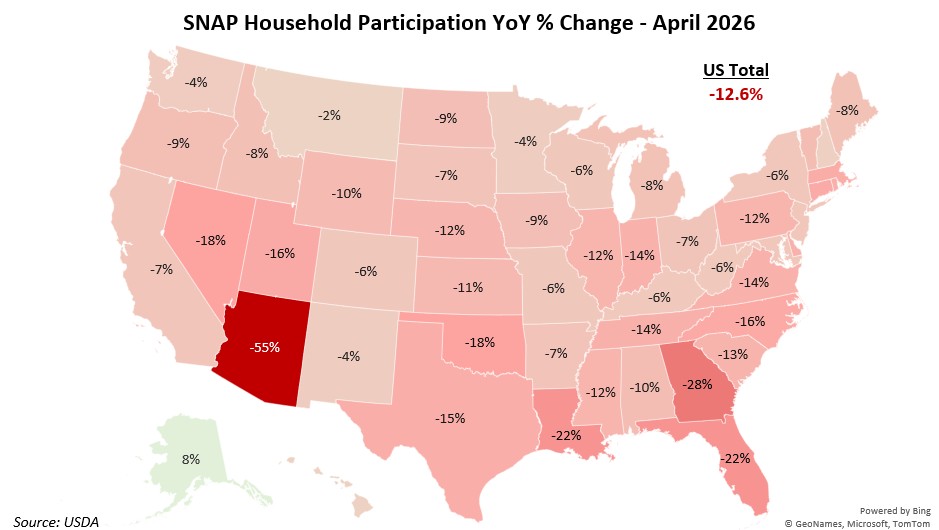
Arizona has been the hardest hit by these changes, materializing in a 55% reduction in SNAP participation from April 2025 to April 2026. Other states, such as Florida, Louisiana, Oklahoma, and Georgia, are also reporting a substantial decline in SNAP participation. At the same time, the southern US has some of the highest rates of food insecurity, according to 2024 USDA data. Unfortunately, it will remain a mystery whether the loss of SNAP participation in these areas contributes to higher levels of food insecurity, as the USDA ended funding for the Household Food Security Report after 30 years in September 2025.
The OBBB also pushed greater responsibility for funding SNAP benefits onto the states. Starting in October 2026, states must cover 75% of SNAP administrative costs, up from 50% in 2025. In October 2027, states will bear the burden of up to 15% of SNAP benefit costs based on the state’s payment error rate—a metric the USDA says measures “how accurately states determine who is eligible for SNAP and how much they should receive”. States with error rates between 6-8% will pay 5% of total benefit costs, 8-10% will pay 10%, and states above a 10% error rate will pay 15% of total benefit costs. However, many states are far from the 6% error rate threshold: In fiscal year 2025, the average US payment error rate was 10.6%. Just nine states were below 6%, six states were between 6-8%, sixteen states were in the 8-10% error range, and nineteen states had error rates greater than 10%. Although some states with abnormally high error rates, such as Alaska (23%) and New Jersey (16%), have delayed implementation, if the same error rates persist, 44 states will bear the increased cost of SNAP benefits, which some may not be able to afford. This change could incentivize states to reduce SNAP benefits to limit error rates, leaving even more Americans off the program.
The passage of OBBB also created headwinds to passing a new Farm Bill, as SNAP is typically included in the Farm Bill rather than a Budget Reconciliation Bill. Along with increased work requirements and shifting costs to states, the OBBB also included re-evaluating the Thrifty Food Plan used to calculate food assistance benefits, and the termination of the National Education and Obesity Prevention program (also known as SNAP-Ed), which provided nutrition classes, grocery store guides, and cooking instruction to low-income families. Altogether, these changes have not gone well in the Senate and House agriculture committees, which will need to incorporate them into the new Farm Bill. As a result, OBBB’s SNAP changes have further stalled progress on a new Farm Bill that is already three years overdue, which inhibits all other changes that a new Farm Bill would bring to US agriculture.
But what does this all mean for food spending and, most importantly, dairy? The USDA estimates an average SNAP spend of $187.20 per person per month. Taking the 12.6% YoY decline, which represents a loss of 5.3 million people, and multiplying it by the average monthly spend per person yields a $1 billion per month loss in grocery spending through the program.
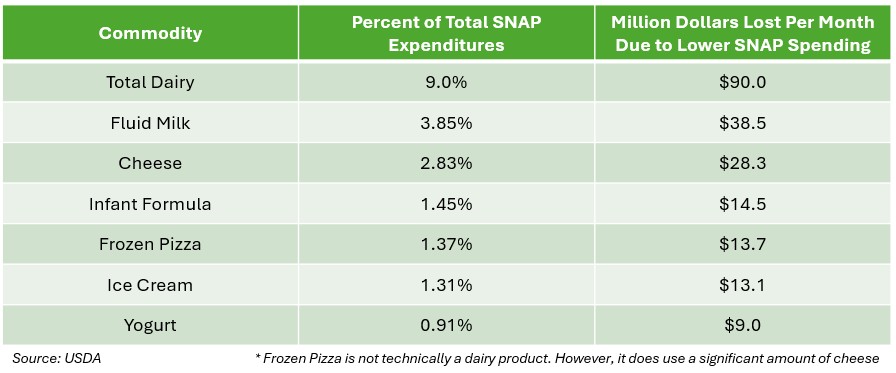
Breaking it out further, in 2016 the USDA did an analysis of foods typically purchased by SNAP households using 2011 data. The agency has never done an updated study, so while the information at this point is old, it is the best available. The USDA reports SNAP households spend 9% of their allotted benefits per month on dairy products. Doing the math, the decline in SNAP participants over the past year should equate to a loss of roughly $90 million per month in dairy grocery purchasing from those benefits. The table below further breaks down this decline by the most-purchased dairy products via SNAP.
Other data support the thesis that grocery sales are falling due to reduced SNAP dollars.
Ahold Delhaize, a grocery store conglomerate on the US East Coast, reported in its latest quarterly earnings report that the loss in SNAP benefits cut sales growth by 0.4%, and SNAP sales account for roughly 5.3% of the company’s total sales. Retail data provided by Dairy Management Inc. indicate that the cheese purchase rate is down 1.8% in June from a year ago; Americans are buying less cheese per trip and less often. This data also shows that retail fluid milk sales are down 0.3% year-to-date through June and are at the lowest level for the month in the past four years. With fluid milk being the second most purchased commodity via SNAP benefits and cheese following at number five, it is likely that the reduction in SNAP participation had some impact on the purchase volume of these household staples.
One last point is that those who no longer meet the requirements to qualify for SNAP benefits remain hungry and turn to food banks for help. The Arizona Food Bank Network noted that in just the first six months of 2026, the average number of individuals served at food banks each month exceeded the total served in 2025. In June, Catholic Charities in Galveston, Texas, reported seeing an additional 9,500 new families, while the MANNA Food Bank in North Carolina reported its highest level of need in nearly four decades. Food banks rarely have refrigeration and often do not accept perishable items, meaning even at food pantries, dairy consumption suffers.
The increase in SNAP work requirements and reduced funding for the program have already resulted in the loss of benefits for 5.3 million Americans, most of whom are not better off and are unable to meet these lofty requirements, thereby losing access to food, as evidenced by the increase in food bank visits. $1 billion per month is no longer spent on groceries through the government program, including dairy products. While the overall impact on dairy markets may be minor for now, the outlook appears to worsen. Persistent inflation, a poor jobs market, and rampant consumer debt continue to pressure American finances. If the decline in SNAP participation persists, fewer dollars will be available for groceries, forcing consumers to choose their staple foods carefully. Dairy has a strong reputation and an excellent nutritional profile, but if food insecurity in the US intensifies, Americans’ best options will be cheap, filling, and shelf-stable products.