On February 1, 2025, US President Donald Trump imposed 25% tariffs on certain Mexican and Canadian imports as well as a 10% tariff on Chinese goods. Then, on April 2, 2025, Trump announced a broad package of tariffs ranging from 10% to 49%, affecting over 180 countries across the globe. The new tariffs took the world by storm, throwing American equity markets into a tailspin, heightening geopolitical volatility, sparking trade wars, and leading to multiple new trade deals.
Over the course of 2025, the United States government collected roughly $287 billion in duties, taxes, and fees, UP 192% from the prior year, according to the Federal Reserve Bank of Richmond. Of this total, approximately $130-$175 billion is estimated to have come from the additional tariffs imposed by President Trump. However, on February 20, 2026, the US Supreme Court struck down these tariffs as unconstitutional, throwing the world back into trade chaos once again.
To enact sweeping tariffs across the board in 2025, the Trump administration used two Acts to impose tariffs.
-
The National Emergencies Act (NEA). Established in 1976, this allows the president to activate special powers during a national crisis. The Trump administration cited fentanyl trafficking as a national emergency to declare this law.
-
The International Emergency Economic Powers Act (IEEPA). This act was established in 1977 and authorizes the president to regulate international commerce after declaring a national emergency in response to any unusual or extraordinary threat.
While Trump invoked the NEA in his first term to use federal funds for the construction of the border wall, the IEEPA has been the primary point of contention, as the act has not previously been used to impose tariffs, only sanctions. The Trump administration cited fentanyl trafficking and illegal immigration as the “unusual or extraordinary threat” to invoke this law, which has then been the main justification behind additional tariffs implemented on February 1 and April 2, 2025.
Since the establishment of these tariffs, more than 1,000 companies, including Costco Wholesale, Toyota, Barnes and Noble, Dole Fresh Fruit Company, e.l.f Cosmetics, Reebok, and many others have filed suit challenging their legality. The cases rose through the court system to the US Supreme Court, where the court announced its final decision on Friday, February 20. In a 6-3 decision, the court found that Trump’s use of the 1977 IEEPA exceeded his authority and that the act did not grant him the power to impose tariffs. Chief Justice Roberts wrote in his opinion that Article I, Section 8, of the US Constitution sets forth the powers of the Legislative branch, that only Congress has the power to lay and collect taxes, duties, imposts, and excises, not the president. He went on to say, “… the president must ‘point to clear and congressional authorization’ to justify his extraordinary assertion of the power to impose tariffs. He cannot.”
With this ruling, challenges arise on both the domestic and international fronts.
Domestic: The challenge remains the issue of returning the collected tariff money. Many companies allege that, because the tariffs were unconstitutional to begin with, the revenue collected was also illegal and should therefore be returned. However, this is no easy feat, as it is unclear how much each company paid in tariffs. One of the three dissenting Supreme Court Justices, Brett Kavanaugh, wrote, “The Court says nothing today about whether, and if so how, the Government should go about returning the billions of dollars that it has collected from importers. But that process is likely to be a mess, as was acknowledged at oral argument.” Furthermore, the New York Federal Reserve reports 90% of tariffs imposed on imported goods are borne by American companies and consumers. While companies filing suit against the US government may receive some form of compensation for illegally collected taxes, American consumers will likely see none.
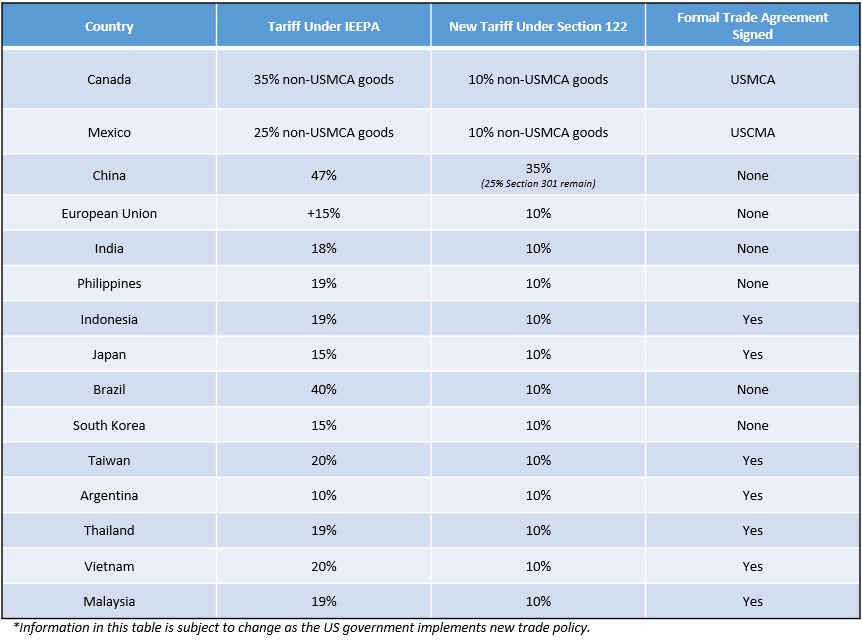
International: The second issue in question is how the Trump administration plans to handle trade negotiations and tariffs going forward. Following the Court’s decision, Trump announced plans to replace the prior tariffs with a new across the board 10% levy via Section 122 of the 1974 Trade Act, which allows the president to impose tariffs for 150 days without congressional approval under specific circumstances, including “large and serious” balance of payments deficits. The new tariff measures were implemented on Tuesday, February 24, 2026, the same day that the U.S. Customs and Border Protection agency halted collections of IEEPA tariffs. Trump threatened a 15% tariff originally, but it is unclear when the 15% rate hike will take effect. Many countries have already signed trade agreements with the US, but as these nations made concessions in exchange for specific tariff treatment that was grounded in the IEEPA, the legal basis no longer exists, leaving the standing of these agreements now questionable.
Malaysia, Vietnam, Thailand, Indonesia, and Taiwan all signed agreements in 2025 lowering the threatened tariff rates of >25% to 19-20%. After the Supreme Court’s decision, Trump’s trade representative, Jamieson Greer, said that the United States would stick to its agreements it had reached, and expected partners to do the same. He also noted that many nations want to see how this plays out first before making any decisions. In some cases, such as with Indonesia, the nation has chosen to stand by their agreed upon trade deal of 19% tariffs despite the US court decision.
Although China has not formally signed a trade deal with the US, in 2025, they agreed to a one-year “truce” that set tariffs on Chinese goods into the US at a 47% maximum made up of a 10% baseline, 10% “fentanyl tariff”, and 25% Section 301 tariffs. The court’s decision effectively lowers the tariff rate on Chinese goods by removing the 10% baseline and 10% fentanyl tariff while the 25% Section 301 tariff remains. Currently, China is reportedly making a “full assessment” of the US Supreme Court tariff ruling. Trump is set to meet with Chinese President Xi Jinping in late March or early April this year, with expectations that tariffs will dominate the discussion. Along with China, both India and South Korea have delayed plans to finalize a trade deal with the US following the Supreme Court’s decision.
Following Trump’s renewed threats to annex Greenland in 2026, the European Union postponed the vote on the trade deal with the US. Now, on February 23, they have once again postponed voting on the US-EU trade deal that would set a minimum of 15% levies on goods imported from the EU. Many European lawmakers have complained that the trade deal is lopsided and are now suggesting a possible re-negotiation, given that the initial tariff threats are void.
For Mexico and Canada, the two closest trading allies of the US, the Supreme Court’s ruling has a less intense impact but will result in reduced tariffs on certain items. Mexico has generally come out unscathed by the tariff turmoil, with tariffs only added to items excluded from the US-Mexico-Canada trade agreement (USMCA). In February, the US House of Representatives voted to terminate Trump’s tariffs on Canada. The resolution is expected to pass the Senate, which has voted twice now to block Trump from imposing tariffs on Canada. However, it is unlikely to become law as it would require a two-thirds majority vote in both chambers to overcome the expected Trump veto. The USMCA agreement is also scheduled for review in July 2026, which could bring some interesting developments. The deal was first signed in 2019 during Trump’s first term in office and includes a “sunset clause” that requires all three nations to agree on whether to extend the agreement for another 16 years. Failure to agree will not lead to an immediate end; instead, the deal will terminate in 2036.
Conclusion: For now, it remains unclear whether and how the US Supreme Court and the Trump administration plan to repay the collected tariffs. While many trade deals have been finalized, several important ones, such as those with the EU, China, and India, have not, which means the current framework could change. The USMCA review is set for July, at the same time Trump’s new 10% tariffs are set to expire, so it is difficult to say what may happen. This development only adds to geopolitical uncertainty, and so long as it persists, market volatility will as well. With the US mid-term elections also set for November this year, a very capricious 2026 lies ahead.
If you have any questions, please reach out to us at info@highgrounddairy.com, and we will get back to you as soon as possible.